|
Mossman Central Mill’s total cane production area is 8,500 hectares. It stretches from Daintree in the north to Mowbray in the south and as far west as Julatten on the Atherton Tablelands.
The mill is supplied by 177 farms, owned by 78 growers. The largest farm assigned to Mossman Central Mill is 436 hectares and the smallest is 5 hectares. The average farm size is 107 hectares.
The Mossman district receives a varied annual average rainfall. |
 |
|
Mowbray, the most southern cane growing area receives approximately 1600 mm, Mossman township receives approximately 2400 mm, whilst Daintree in the north receives approximately 4000 mm. All cane is grown without irrigation. The average production for farms on the coast is approximately 80 tonnes of cane per hectare.
Growers are paid per tonne of cane, according to the sugar content. The price in recent years has hovered around the $25 mark. The price that is quoted on the radio and television is normally a price for sugar, not sugar cane.
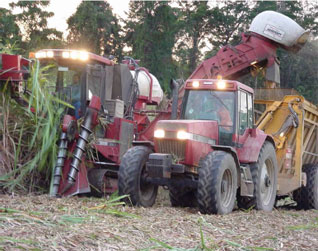
Approximately 95% of cane in the Mossman region is cut green. Crops are only burnt if they are particularly tangled and difficult to harvest, or as a means of removing excess trash from the paddock if the old crop is to be ploughed out and replanted. |
 | |
 |
|
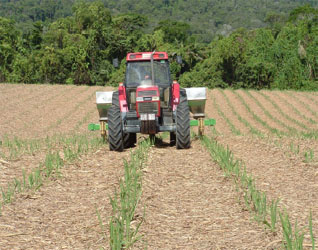
A single crop of cane takes a full year to reach maturity. After harvest the cane root section (stool) is fertilised and will re-grow (ratoon) for the next year's crop. On average, a crop of cane will last approximately 5 years before it has to be ploughed out and replanted.
There are approximately 20 different varieties of cane grown in the Mossman region. Some are better suited to certain conditions and soils than others, and over time some become susceptible to disease and lose their quality. New varieties of cane are constantly being developed.
A crop of cane flowers in early May through June. Flowering is not an indication if plant maturity, it is simply a varietal characteristic. Some varieties rarely flower. |
 |
| Different varieties of cane produce the same finished product; however, some varieties contain more sugar than others. Growers are paid according to the weight and sugar content of their crop. Sugar content is referred to as ccs which is the abbreviation for Commercial Cane Sugar.
Sugar cane is a heavy feeder of nutrients and uses some 20 kg of phosphorus, 120 kg of potash and 120 to 160 kg of nitrogen per hectare, depending on the variety or soil type.
Download this fact sheet here! | |
